Quick Answer:
What is a photovoltaic carport? It's a building facility that combines solar photovoltaic modules with the roof of a parking shed, generating electricity from solar energy while providing shade and rain protection, achieving "dual use of one location."
How much electricity can it generate? Taking an aluminum alloy photovoltaic carport as an example, each parking space can generate 3500-4500 kWh of electricity per year (depending on sunshine conditions). The generated electricity can be directly used for lighting, charging, or fed into the grid.
Is the investment worthwhile? The static payback period for a pure photovoltaic carport is approximately 8-10 years, with an internal rate of return (IRR) of approximately 5%-8%. If combined with energy storage and charging piles, the payback period can be shortened to 3-7 years, and the IRR can be increased to 8%-15%. Some solutions show that the average annual green electricity revenue per parking space exceeds 4000 yuan, with an incremental cost payback period of only 2.8 years.
Where is it suitable for installation? It is applicable to industrial parks, commercial complexes, schools, hospitals, public parking lots, communities, highway service areas, etc.
Summary: Five core points of photovoltaic carports
▪ Dual-use in one place: It does not occupy additional land, generates electricity above the existing parking space, and provides sunshade and cooling at the same time. The temperature under the shed can be reduced by 3~5°C.
▪ The structure is exquisite: according to the number of columns, it is divided into single column and double column. Single column saves space and is easy to install; double column has stronger wind resistance, saves steel and has a more stable structure.
▪ Materials determine lifespan: Aluminum alloy brackets are corrosion-resistant, maintenance-free, and suitable for coastal and high-humidity areas; carbon steel brackets have strong load-bearing capacity and controllable costs, and are suitable for large-span scenarios.
▪ Integration of light, storage and charging is a trend: after integrating photovoltaic power generation, energy storage systems and charging piles, self-use of energy, surplus electricity storage, and peak and valley arbitrage can be achieved, and the economics are significantly better than pure photovoltaic solutions.
▪ The selection depends on the scenario: site conditions, climate environment, vehicle size and electricity demand jointly determine the structural form and material selection of the carport. It is not recommended to base decisions solely on the initial cost.
I. Composition and Working Principle of Photovoltaic Carports
A complete photovoltaic carport system consists of photovoltaic module arrays, a support system, an inverter, a power distribution system, a lighting and control system, and a lightning protection and grounding system. Upgrading to an integrated photovoltaic-energy storage-charging solution requires the addition of an energy storage system and charging pile equipment.
The workflow can be simply understood as follows: Photovoltaic modules on the carport roof convert sunlight into direct current (DC) → DC is collected by a combiner box and transmitted to the inverter → The inverter converts DC into alternating current (AC) → The AC powers the carport lighting and charging piles, with surplus power fed into the grid.
The key feature of photovoltaic carports is that photovoltaic modules directly replace the traditional carport roof. Therefore, they are both power generation equipment and structural components of the carport, making it one of the simplest and most widely used forms of building-integrated photovoltaics (BIPV).
II. Core Content: In-depth Analysis of Two Mainstream Support Systems
The support system of a photovoltaic carport determines its structural form, lifespan, and applicable scenarios. Currently, the mainstream support solutions on the market are divided into two main categories: aluminum alloy supports and carbon steel supports.
2.1 Aluminum Alloy Photovoltaic Carport Support System
The aluminum alloy support system uses AL6005-T5 as the main material, with an anodized surface treatment. Its core advantages are:
Outstanding Corrosion Resistance: Aluminum alloy has inherent oxidation resistance, and anodizing further enhances its anti-corrosion performance. It is resistant to rust even in coastal environments with high salt spray, acid rain, and de-icing salt. No rust removal or repainting is required throughout its service life, resulting in extremely low maintenance costs.
Lightweight and High-Strength: Weighing approximately 60% of steel structures, it can withstand wind speeds up to 60 m/s and snow loads of 1.4 kN/m², reducing the load-bearing requirements of the foundation.
Modular and Quick-Assembly: The modular design supports rapid on-site assembly, allowing for flexible expansion of parking spaces or the number of photovoltaic panels later.
Waterproofing and Cooling: Equipped with structural drainage channels for physical waterproofing; the photovoltaic panels block sunlight, reducing the temperature under the canopy by 3-5°C.
Key parameters (taking SolarFirst products as an example): Material is anodized aluminum alloy AL6005-T5, with matching stainless steel SUS304 fasteners; maximum wind load 60m/s, snow load 1.4kN/m², and a 10-year warranty.
For product details, please refer to: :Aluminum Solar Carport Mount System
2.2 Carbon Steel Cantilever Carport Support System
The carbon steel support system uses hot-dip galvanized carbon steel as its main material, achieving corrosion protection through the hot-dip galvanizing process. Its advantages include:
Stronger load-bearing capacity: Steel has higher strength and stiffness than aluminum alloys, making it suitable for designs with large spans, heavy loads, or requiring long cantilever sections.
Relatively controllable cost: In large-scale projects, the initial material cost of carbon steel supports is typically lower than that of aluminum alloy solutions.
Suitable for extreme climates: After proper hot-dip galvanizing, carbon steel supports perform stably under harsh climatic conditions such as extreme cold and strong winds.
Carbon steel supports require more attention to the corrosion protection of bolt connections and cut edges, as these areas are weak points where corrosion is concentrated. Regularly checking the tightness of bolts and the integrity of the anti-corrosion coating is a key aspect of operation and maintenance.
Product details can be found at: Steel Cantilever Carport Mount System
2.3 Classification and Selection of Structural Forms
Besides material differences, photovoltaic carports can be classified in several dimensions based on their structural forms:
By the number of columns: Single-column carports save space, offer convenient parking, and are easy to install; double-column carports are more stable, have stronger wind resistance, and use less steel per unit area.
By slope shape: Single-slope structures are suitable for north-south orientation, are simple in structure, and easy to install; double-slope structures have centralized drainage, are suitable for east-west orientation, and offer more convenient drainage during rainy days.
By the relationship between photovoltaics and the structure: Add-on structures are suitable for upgrading existing carports by installing photovoltaic modules on the existing roof; modular structures use photovoltaic modules directly as structural components of the carport, are simpler and more aesthetically pleasing, but have higher design complexity.
III. Comparison Table
3.1 Aluminum Alloy vs. Carbon Steel Support System
| |
Aluminum carport |
Steel Cantilever Carport |
| Main materials |
Anodized Aluminum AL6005-T5 |
Hot Dip Galvanized Steel |
| Weight |
Approximately 60% of the steel structure |
Heavier, with slightly higher requirements for the foundation. |
| Anticorrosion performance |
Excellent, anodized treatment, suitable for coastal/high humidity environments |
Good (depending on the galvanized coating), attention should be paid to the cutting edges and bolt connections. |
| Load-bearing capacity |
High (wind load of 60 m/s, snow load of 1.4 kN/m²) |
Higher, suitable for long-span and heavy-load scenarios |
| Installation ease of use |
Modular design, rapid on-site assembly |
It requires welding or high-strength bolt connections, and the construction process is relatively complex. |
| Post-maintenance |
Almost maintenance-free, no need for repainting |
It is necessary to regularly inspect the zinc coating and the condition of the fasteners. |
| Applicable scenarios |
Coastal areas, high humidity environments, commercial plazas, residential communities |
Industrial park, large-span parking lot, logistics center |
| Warranty period |
10 years |
Usually 5 to 10 years (depending on the thickness of the galvanized layer) |
3.2 Comparison of Different Function Configuration Options
| Scheme type |
Core configuration |
Investment payback period |
Applicable scenarios |
| Pure photovoltaic carport |
Photovoltaic module + support + inverter |
8 to 10 years |
There are already stable power supply scenarios, with self-use being the main purpose. |
| Integrated photovoltaic, storage and charging system |
Photovoltaic + Energy Storage + Charging Stations + Smart Platform |
3 to 7 years |
Zero-carbon park, high-traffic station, expressway service area |
| Modified carport |
Adding photovoltaic panels and optimizers to the existing carports |
5 to 8 years |
Both the parking lots are being upgraded, but the budget is limited. |
IV. Case Studies and Benefit Calculations
Case Study 1: Sudbury 300KWp Carbon Steel Waterproof Carport Project. Located in Sudbury, this project involved an installed capacity of 300KWp. The carport type was a carbon steel waterproof carport, and construction was completed in March 2022. This project demonstrates that carbon steel waterproof carports possess excellent structural load-bearing capacity and cost advantages in medium to large-scale carport projects. The waterproof design protects vehicles and electrical equipment underneath, making it suitable for scenarios sensitive to initial investment and requiring large spans.
Case Study 2: Malaysia 1.6MWp BIPV Carport Project. Located in the Q-cell factory area in Malaysia, this project involved an installed capacity of 1.6MWp. The product type was a cantilever waterproof carport/BIPV carport, and construction was completed in 2019. As a megawatt-level photovoltaic carport project, it demonstrates that BIPV carports can meet the large-scale self-consumption needs of industrial parks. The cantilever structure reduces the footprint of columns, improving parking and traffic efficiency within the factory area.
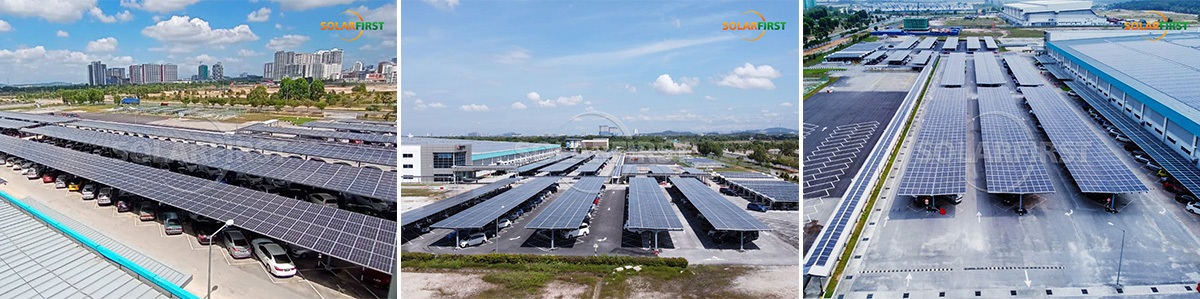 (1.6MWp BIPV Carport Project in Malaysia )
Case Study 3: Thailand 296KWp Carbon Steel Waterproof Carport Project. The first project, located in Bangkok, Thailand, has a total capacity of 295.925 KWp and uses carbon steel waterproof carports. Bangkok has a hot and humid climate with concentrated rainfall during the rainy season, requiring high standards for corrosion resistance and drainage in the carports. This project demonstrates that the carbon steel frame, treated with standardized hot-dip galvanization and featuring a waterproof design, is suitable for the hot and humid climate of Southeast Asia, making it suitable for commercial parks, factory parking lots, or public parking areas.
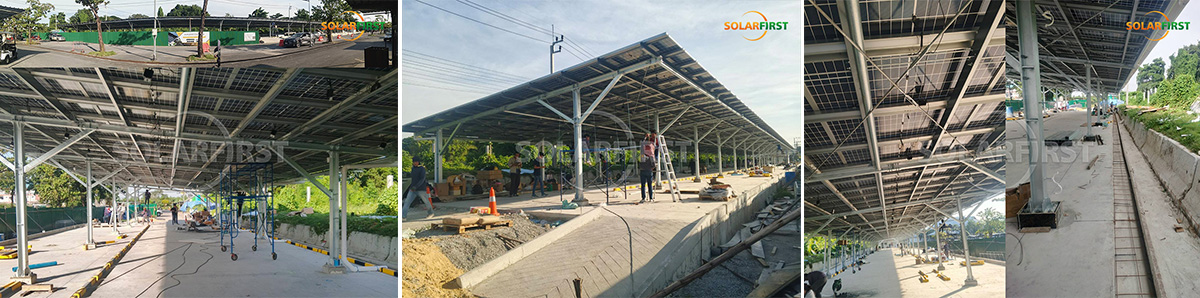 (296KWp Carbon Steel Waterproof Carpark Project in Thailand )
Case Study 4: 640 KWp Solar Carport Project in Japan. This project has an installed capacity of 640 KWp (6.4 KW × 100), using aluminum alloy carports, and was completed in 2018. The project consists of 100 parking spaces, with approximately 6.4 KW per space, representing a standardized, modular solar carport solution. Aluminum alloy carports are lightweight, corrosion-resistant, and maintenance-free, making them suitable for markets with high humidity and coastal environments.
These case studies demonstrate that photovoltaic carports have been successfully implemented in various climates and markets: aluminum alloy carports are preferred in high-humidity and coastal areas, while carbon steel waterproof carports are suitable for large-span, cost-sensitive projects. BIPV/cantilever waterproof carports are suitable for large-scale projects in industrial parks. When selecting a carport, climate, structure, corrosion resistance, drainage, operation and maintenance, and long-term benefits should be considered comprehensively. The main structure of a photovoltaic carport typically has a lifespan of up to 25 years, providing a long-term return on a one-time investment.
V. FAQ: Frequently Asked Questions
Q1: How much more expensive is a photovoltaic carport compared to a regular carport?
The construction cost of a photovoltaic carport is approximately 300-400 yuan per square meter higher than a regular membrane structure carport. However, the increased cost can be recovered within several years through electricity generation revenue.
Q2: How to choose between single-column and double-column supports?
If the site is compact and convenient parking is a priority, a single-column solution is preferred. If the area has high wind loads or requires a larger span, double-column supports offer advantages in structural stability and steel consumption per unit area.
Q3: How to choose between aluminum alloy and carbon steel brackets?
In coastal areas, high humidity areas, or areas prone to acid rain, aluminum alloy brackets are recommended as their maintenance-free nature significantly reduces long-term operation and maintenance costs. In dry inland areas with limited budgets, hot-dip galvanized carbon steel brackets are an economical and practical choice.
Q4: What approval procedures are required for a photovoltaic carport?
Although photovoltaic carports are located within the designated construction land area, they risk being deemed illegal structures if lacking the necessary construction planning permits, potentially resulting in non-compensation during demolition. It is recommended to obtain the necessary permits from the local planning department before construction.
Q5: Is daily maintenance complex?
The support system of aluminum alloy carports is essentially maintenance-free. Photovoltaic modules should be cleaned at least quarterly, with increased frequency in heavily polluted or windy areas. Regular checks should also be performed on bolt tightness, the grounding system (grounding resistance ≤4Ω), and the condition of the anti-corrosion coating.
Q6: Can the electricity generated by the photovoltaic carport directly charge electric vehicles?
Yes. The DC power generated by the photovoltaic modules is converted to AC power by an inverter and can be directly supplied to AC charging stations. If an energy storage system is configured, a complete closed loop of "photovoltaic power generation → energy storage → charging station discharge" can be achieved, releasing stored energy during peak electricity price periods to achieve peak-valley arbitrage.
Q7: Will shading affect power generation?
Yes, it will. The shadows cast by surrounding buildings, trees, or other carports should be taken into consideration. When encountering shading, consider adjusting the carport's location to avoid obstacles, or using optimizers or micro-inverters to reduce the impact of localized shading on overall power generation.
The value of photovoltaic carports lies not only in the combined functions of "parking + power generation," but also in transforming idle parking space into a sustainable, revenue-generating green energy asset. Choosing the right structural form and support materials is a crucial step in ensuring a long-term, stable return on this investment.



 en
en fr
fr de
de zh-CN
zh-CN ru
ru es
es pt
pt ja
ja ko
ko ar
ar